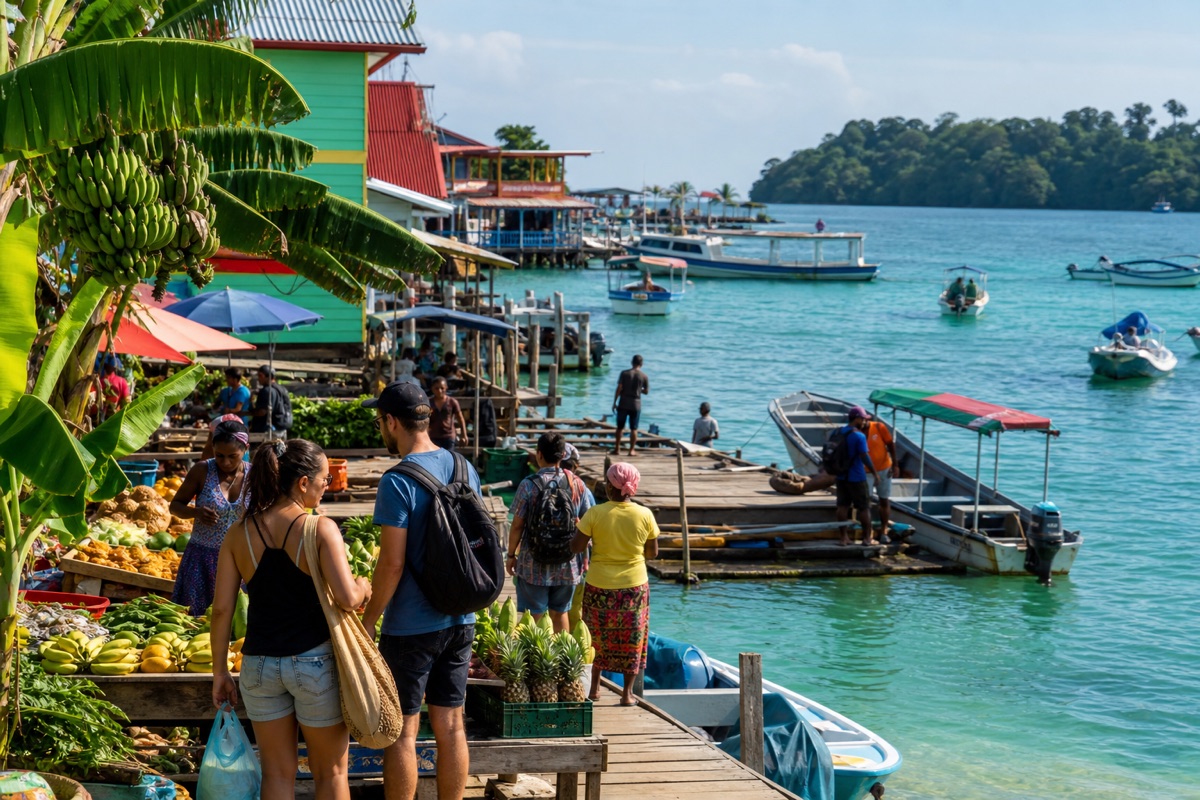

It’s starting to go “Bananas” in Bocas del Toro.


The government distanced itself from the request of the independent producers who leased land to the Chiquita Brands subsidiary, a company that abandoned the plantations, leaving some 900 workers unemployed.
Nearly 1,000 hectares of land leased by the banana company Chiquita Panamá LLC to independent banana growers in the province of Bocas del Toro remain abandoned. These areas were excluded from negotiations between the government and the multinational corporation. While the banana growers warn of an economic downturn in the region, the authorities distance themselves from the problem, claiming it is a matter “between private parties.”
“The much-publicized reactivation of banana production in Bocas del Toro by the Government failed to mention that 1,000 hectares were left out, which have not been reactivated and are flooded and completely abandoned, due to the memorandum of understanding between Chiquita and the Panamanian State,” stated Luis Nuques, of the Association of Industrial Banana Producers of Bocas del Toro (APIB), on his social network X.
The province is mired in a severe economic depression and there are no government projects to revive it, he added. These are lands that independent banana growers leased to Ilara Holding Inc., a subsidiary of Chiquita, and where some 900 people worked who are now unemployed.
The plantations were abandoned by the company alleging “force majeure or fortuitous event”, which prevents it from continuing with the activity, according to the interpretation of the transnational, APIB explained in a letter addressed to President José Raúl Mulino, with copies to the Ministries of Commerce and Industries (Mici), Economy and Finance and Agricultural Development, the Attorney General’s Office, and the Banana Commission.
It is a crop that, since the 19th century, “even when we were part of Gran Colombia, has not been immune to strikes and social upheavals, but it has survived them,” added the banana growers who leased the land. Therefore, they demanded that the strike that began at the end of April not be considered “a force majeure event to justify the company’s permanent and irresponsible abandonment of the land.”
The banana growers point out that the contract establishes as causes for early and unilateral termination the “floods, earthquakes, diseases or abnormal pathologies of the crop, new taxes that affect the activity, claims from third parties that affect the possession and exercise of the lease agreement, and breach of contract by the lessor.”
Therefore, the representatives of the companies Embasa, Mauligo, Agrícola del Atlántico and Agrobocas emphasize that the strike decreed by the Union of Workers of the Banana, Agricultural and Related Industries (Sitraibana) from April 28 to June 11, 2025, “does not constitute” a force majeure event.
Despite this, the banana growers indicate that Ilara Holding Inc. informed them of the termination of their contracts a month after the strike ended, “when the force majeure event had already ended,” APIB states. There was no agreement between the parties, and, as they explained, the strike does not constitute an event that allows for the early termination of the contract nor does it permanently prevent the resumption of production activities.
They argued to the ruler that “this is a national problem” because the producers’ farms are at risk, and they requested that the State take legal action and include them in the talks with Chiquita and its subsidiary Ilara for a “fair and equitable” solution, according to the August 2025 article.
However, this request was not considered and the Government announced, on June 11, 2026, a memorandum of understanding that included only the 5,000 hectares of the State.
“Those farms [of the independent growers] were lost, no bank or government is going to give a penny for bananas because it is a risky crop,” explained a banana businessman who also said that they are affected by the black sigatoka disease.
La Estrella de Panamá tried to contact Chiquita Panamá through its agricultural department and its comptroller, but they did not answer.
Similarly, this media outlet contacted the Ministry of Commerce and Industry (MICI) and sent a questionnaire asking why independent producers were not included in the agreement, why the transnational corporation has not been required to maintain the plantations, and what plan there is for the 900 unemployed, among other questions, but the MICI did not answer any of the specific questions.
In contrast, the Ministry of Commerce and Industry (MICI) indicated that the recovery of the banana sector in Bocas del Toro represents one of the most important economic reactivation processes for the country after the 2025 crisis, and that following the government’s actions, 5,065 jobs were recovered and 5,000 hectares of crops were reactivated.
The ministry added that the government’s priority is to preserve employment and strengthen the province’s productive stability, and that dialogue has been maintained with the various sectors.
Last month the government responded to APIB that “disputes arising from contractual relationships, as well as the interpretation, execution, termination or possible breach of private contracts, constitute matters that must be discussed and resolved by the parties involved, in accordance with the conflict resolution mechanisms provided for in the respective contracts and in the current legal system.”
The Sitraibana strike, which took place between April and June 2025, stemmed from protests against Law 462, which reformed the Social Security Fund’s pension system. Following the conflict, the multinational corporation announced its withdrawal from the country, the closure of its operations, and the dismissal of its workers.