The Dog and Pony show over the CANAL will be talk of 2026.
- By : James Bryson
- Category : Canal, Energy/Infrastructure, International Relations
PS: Sra.Palm- Please do NOT forget the powder keg you have in Bocas at “RED FROG”- the people deserve to know.
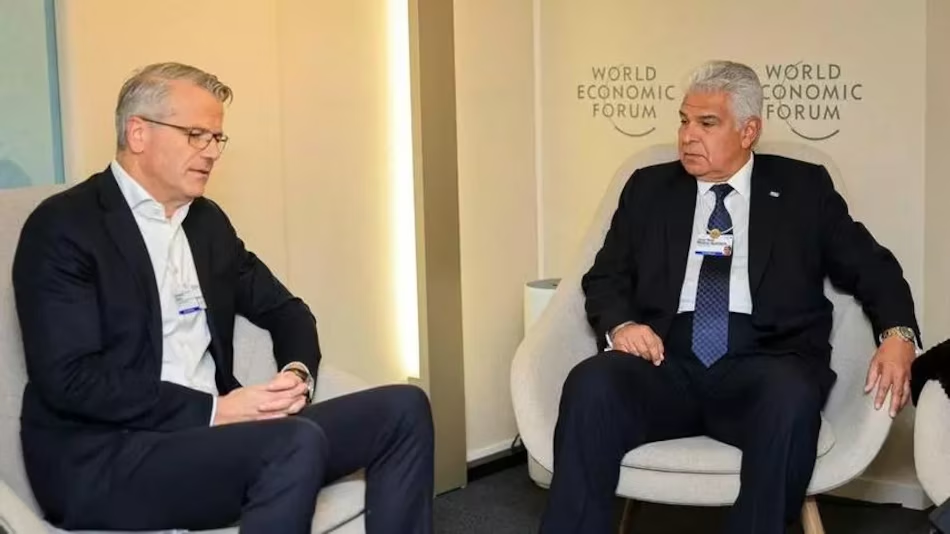
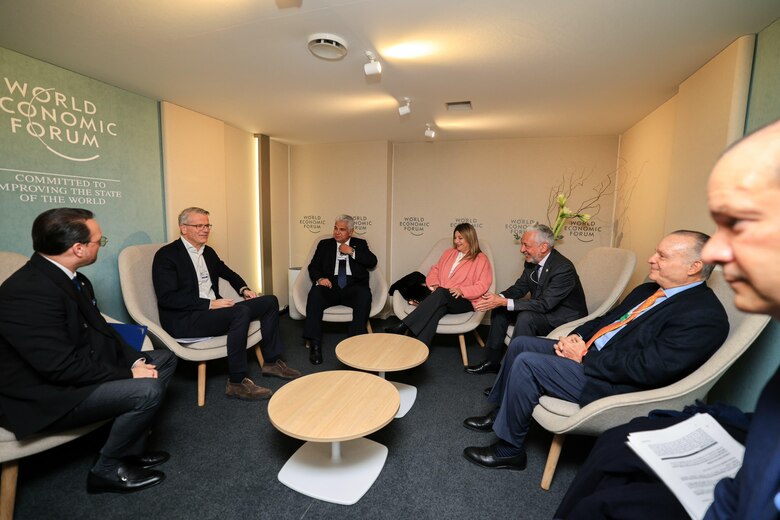
José Raúl Mulino arrived in Davos , a small canton in the Alps, to participate in the World Economic Forum , determined to find “investment opportunities.” With him were the presidential advisor for logistics, Alberto Alemán Zubieta , and the administrator of the Panama Canal Authority (ACP), Ricaurte Vásquez .
His first meeting, immediately upon landing, was with Vincent Clerc , CEO of the shipping company Maersk , the most important client of the port of Balboa , then operated by Panama Ports Company (PPC) , the local subsidiary of Hong Kong-based CK Hutchison .

You might be interested in:
Panama assumes control of the ports of Balboa and Cristóbal following a Supreme Court ruling
There, Mulino asked him if his company was willing to assume temporary management of Balboa, in the Pacific, in the event of PPC’s withdrawal. Clerc, without hesitation, answered affirmatively.
Two days later, the president and his entourage repeated the exercise, but in Zurich , where they had a meeting with Diego Aponte , president of Mediterranean Shipping Company (MSC) . Why did they seek out MSC? Because while Maersk is the main user of Balboa, the Italian company is the main user of Cristóbal, PPC’s other port, on the Atlantic coast. They are also present at PSA Panama , the terminal located in Rodman , across from Balboa.

When Mulino wanted to know if MSC would be willing to operate Cristóbal, Aponte’s response was immediate: “tomorrow”.
But despite Maersk and MSC’s willingness to sell, the Panamanian government still hadn’t decided what to do with PPC. In the meantime, other decisive events occurred: the Balboa and Cristóbal concession contract was challenged in court; US President Donald Trump alleged (without evidence) that China controlled the canal and Panamanian ports; BlackRock announced the purchase of the 43 terminals operated by CK Hutchison (including the two in Panama); and the Comptroller General’s audit revealed that the State had failed to collect at least $1.337 billion in fees and royalties .
“We have been looking at all the options, some crazy ones,” Mulino remarked this Monday, in a meeting at the Presidency of the Republic with representatives of the media, to explain the roadmap adopted, whose planning took more than a year, in order to avoid past mistakes.
“The precedent of the [copper] mine in Donoso was not good…. It is an essential reference point,” he said.
In that vein, he recalled that last year there were even meetings (in New York and Washington ) with CK Hutchison and a representative of the Chinese government, who complained that no one had informed the Chinese Communist Party about the (now failed) intention to sell the ports to BlackRock. It is now known that Panama was also not informed of this alleged transaction, even though the state owns 10% of PPC’s shares. Mulino opined that this shareholding is “cosmetic,” since its supposed partner doesn’t even share its financial statements with it.
The relationship was so strained that the Executive even considered proposing a bill to the National Assembly to modify the PPC contract law. In the end, it opted to wait for the full Supreme Court of Justice (CSJ) to issue a ruling.
The pronouncement finally occurred on January 29th.
That day, the Court declared unconstitutional the contract law, the addenda, and the resolutions of the Panama Maritime Authority (AMP) that, in 2023, extended PPC’s concession until 2047. “The effect of this decision of unconstitutionality must be interpreted to mean that there is no concession,” the Court noted in a unanimous decision.
PPC’s fate was sealed when that ruling was published in the Official Gazette on February 23, 2026 .
Mulino is now concerned that someone might tarnish the process or draw incorrect interpretations. He insists that the executive decree ordering the temporary occupation of Balboa and Cristóbal does not imply a “nationalization” of the ports . In fact, the Cabinet Council has been convened to issue the authorization that will allow the Panama Maritime Authority (AMP) to enter into temporary contracts with APMT Panama (a Maers subsidiary) and TIL Panama , through its parent company Terminal Investment Limited (TIL) , the port arm of MSC, while an international tender is prepared to find a private operator for each port.
This process must be completed in 18 months or less.
“We’re going to get out of this mess as soon as possible,” Mulino predicted.
Attachments
Why was this “contingency plan” chosen instead of holding a public event right away?
“It is impossible to hold a bidding process without having information,” Mulino said.
Furthermore, an inventory of assets is necessary. Although PPC maintains that it has invested $1.8 billion (which forms the basis of one of the two arbitration claims it has already filed against Panama), the president stated that the condition of this equipment is not optimal, starting with the cranes, which lack the capacity to handle Neopanamax vessels . Since PPC cannot remove the equipment or capitalize on its investments, the Executive Branch will compensate the company, “if that is the case.”
Both contracts, which are identical, could be signed, ratified, and published in the Official Gazette this Monday. For now, the Panama Maritime Authority (AMP) controls the ports, and both remain operational.
Alemán Zubieta, who had already met with the Balboa workers, assured them that the temporary operators would assume all labor benefits; no dismissals were anticipated. With him was the Human Resources Director of PPC, the only port executive who remained to face the situation. The top management left Panama two weeks ago.
The presidential advisor estimates that the State could now receive $100 million in contributions over 18 months from fees, royalties, and rents, since several companies subcontracted by PPC operate within the port facilities, occupying state-owned land, and have not yet shared any of their profits. They don’t even pay income tax. This is the case, for example, with ServiEstiba .

These contributions, calculated by Alemán, represent a proportionally higher amount than what Panama would have received had the unconstitutional contract been maintained. With PPC, in 29 years of the relationship, the State only received $483 million, causing the country a loss of $853 million , according to the Comptroller’s audit.
No Comments