My self indulgent post. Please support OCEAN RAMSEY link on homepage.
- By : James Bryson
- Category : "JB", Conservation, Environmental, Human Interest
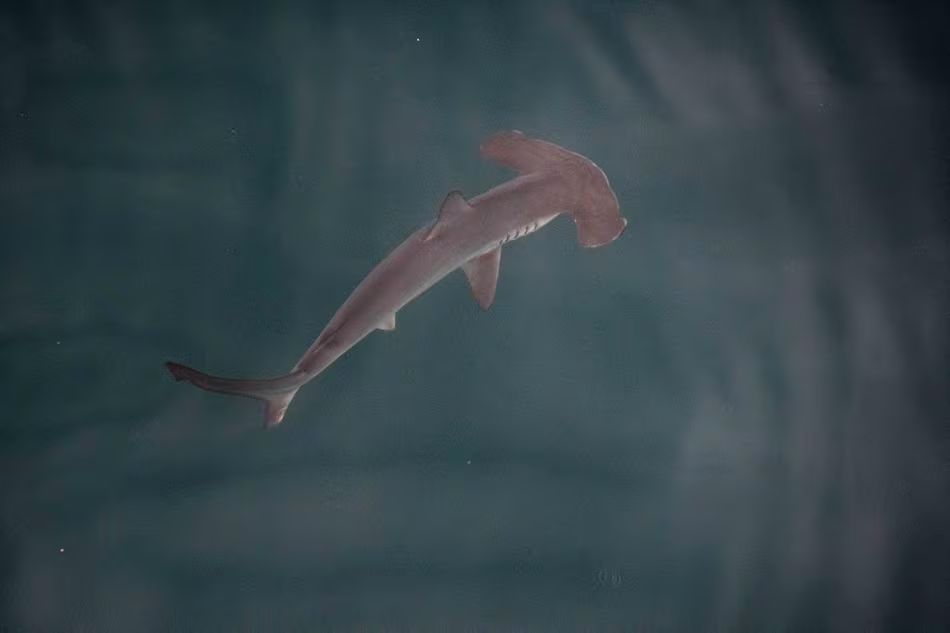
The Galapagos archipelago (Ecuador), along with Malpelo (Colombia), Clipperton (France) and Revillagigedo (Mexico), are home to some of the largest recorded numbers of sharks worldwide, including the critically endangered great hammerhead shark (Sphyrna lewini).
Conversely, coastal Marine Protected Areas (MPAs) show signs of a serious decline, according to one of the most comprehensive studies to date on sharks and other large predatory fish in the Eastern Tropical Pacific (ETP), released this Wednesday by the Charles Darwin Foundation (CDF) and National Geographic Pristine Seas.
The oceanic islands of the Eastern Tropical Pacific are “a window to the past, where sharks and large predatory fish are the norm and not the exception,” said Pelayo Salinas, senior researcher at the FCD.
Salinas, senior author of the study, noted that these areas “offer a glimpse into what a healthy ocean looks like and highlight the key role that marine conservation plays in protecting these last refuges from systematic overfishing.”
The study was led by researchers from the FCD, in collaboration with National Geographic Pristine Seas and the Galapagos National Park Directorate, among other regional institutions.
The team used baited remote underwater video stations to assess sharks and other large predatory fish in four marine protected areas (Galapagos, Malpelo, Clipperton and Revillagigedo) and three coastal areas (Machalilla, Galera, San Francisco and Isla del Caño).
“Oceanic islands, such as Galapagos and Malpelo, are extraordinary places where exceptional populations of sharks and other large predatory fish—such as jacks, groupers, and snappers—still thrive,” while “these species are rapidly disappearing in other areas,” said Simon McKinley, lead author of the study.
Marine protected areas provide protection to marine communities from unsustainable fishing practices, allowing animals to live undisturbed, he said.
Breeding sites
The study confirmed that most of the Galapagos sharks observed in Clipperton were juveniles, suggesting that this marine protected area functions as an important breeding site.
In contrast, larger and more mature individuals were recorded in other island marine protected areas, indicating that these sites function as adult aggregation zones or feeding areas.
In addition, predatory fish communities were found to differ among oceanic islands, likely influenced by regional currents and local environmental conditions such as temperature and food availability.
The hammerhead shark, more common in the south
The common hammerhead shark was most frequently recorded in southern marine protected areas such as Galapagos and Malpelo, while silvertip sharks (Carcharhinus albimarginatus), listed as vulnerable, were more frequently seen in northern MPAs.
These patterns show how each marine protected area harbors distinct assemblages, underscoring the need for management strategies tailored to their unique ecological conditions, according to the study.
In contrast to remote oceanic marine protected areas, studies in coastal zones revealed few large predators and low numbers of fish, signs of a marine ecosystem under pressure, something “worrying” for scientists.
“The sad reality is that, despite being within protected areas, these species have likely been fished unsustainably over time, to the point of being partially or completely eliminated from marine ecosystems,” McKinley said.



No Comments